Housing costs and inequality
A continent struggling with housing costs
In 2025, 7.7% of people in EU private households faced housing-cost overburden. The country estimates below show how the affected population is distributed, not everyone who cannot find a suitable home.
By the numbers
Estimated affected population
≈34,524,000Approximate EU-27 estimate
Largest estimated affected population
Germany · ≈9,361,000
EU private-household overburden rate
7.7% Eurostat EU-27 aggregate
Key insights
Greece has the highest burden rate in the EU at 26.4%.
Denmark at 23.4%* and Sweden at 10.8% are above the published EU rate.
Estimated affected population · shares of the EU total
34.5M
estimated people across the EU
Germany≈9,361,00027.1%
France≈4,408,00012.8%
Spain≈3,537,00010.2%
Italy≈2,947,0008.5%
Greece≈2,738,0007.9%
Poland≈1,496,0004.3%
Denmark≈1,402,0004.1%
Netherlands≈1,173,0003.4%
Other EU≈7,461,00021.6%
Sources: Eurostat, EU-SILC 2025 (ilc_lvho07a) × Eurostat, population on 1 Jan 2025 (tps00001). Counts are approximate (published rate × total resident population), not official survey headcounts: EU-SILC covers people in private households, while the population series also includes other residents. Rates are rounded to one decimal place. Costs include utilities, not rent alone. The 40% test uses costs and income net of housing allowances (Eurostat definition). Verified 11 October 2026. 2025 flags: breaks in the rate series for Denmark and Luxembourg; Lithuania’s rate and France’s population are provisional; Romania’s population is estimated. The EU population aggregate is estimated and provisional. *Denmark has a break in the rate series.
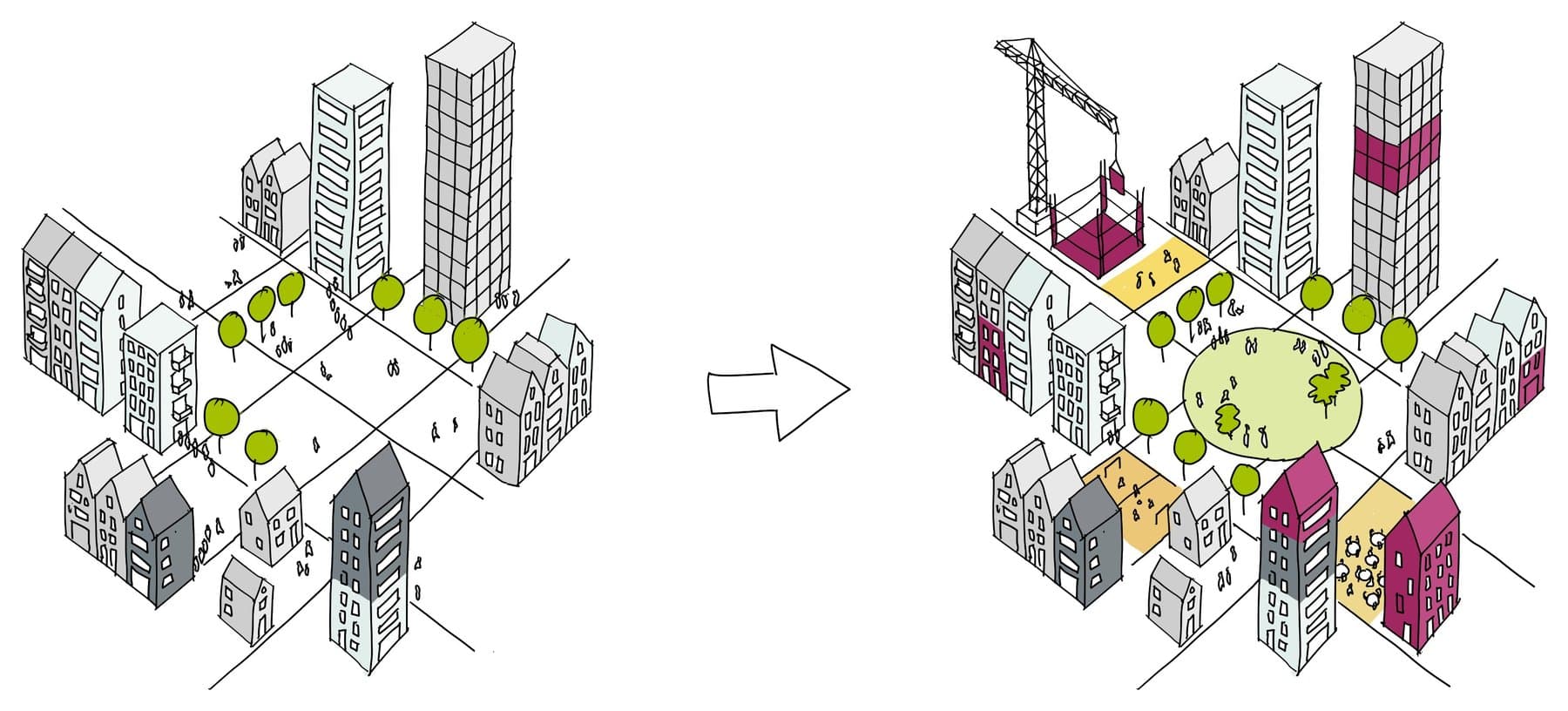
Illustrative housing concept
How shared housing could fit into a neighbourhood
This illustration explores adding community-owned homes to an existing street. It is not a before-and-after record of a Fair Squares project. Affordability depends on each project’s legal terms and agreed duration; it is not guaranteed permanent.
Starting concept
An imagined street with different housing tenures.
Proposed concept
Imagined community-owned homes in magenta, with a shared garden.